
Mauldin Resident Lookup Records
Mauldin has no single citywide register of residents. The useful record trail begins with Greenville County and then moves to the state custodian that holds the needed record. A property result can document an owner’s interest in a parcel. A court index can separate namesakes through a case number, party role, and dates. Probate and marriage paths can provide event evidence, while the election system has tightly defined access and use rules. Each source needs a different level of caution because an indexed name does not by itself prove a current address or household membership.
| Record | What It Can Confirm | Mauldin Route | Access |
|---|---|---|---|
| Assessment record | Owner, parcel context, tax year, and possible mailing-versus-situs comparison | Greenville County Real Property Search | Free public search |
| Recorded documents | Documented land connection, legal description, and recording trail | Greenville County Register of Deeds | Online search and older index routes |
| Trial-court index | Case number, party information, case type, and dated events | Greenville County Trial Court Public Index | Public index; clerk copy for the file |
| Voter registration or list | Defined registration and precinct evidence, with limited participation history in the list product | MySCVotes and the South Carolina Election Commission | Self-service or statutory list route |
| Probate or marriage | Estate, guardianship, marriage-license, or related event trail | Greenville Probate Court | Public case route with protected categories |
| Vital-record product | South Carolina life-event evidence within statutory limits | South Carolina DPH Vital Records | Eligibility and time limits apply |
For a resident lookup, start with the record that matches the question. A name tied to a parcel calls for the county property route and, if needed, the deed index. A case question belongs in the county-limited court search. A marriage, death, or birth question belongs with Probate Court or DPH, not a general name result. The election route can confirm a person’s own registration or support a lawful list request, but it does not reveal ballot choices.
Mauldin Court Record Dockets
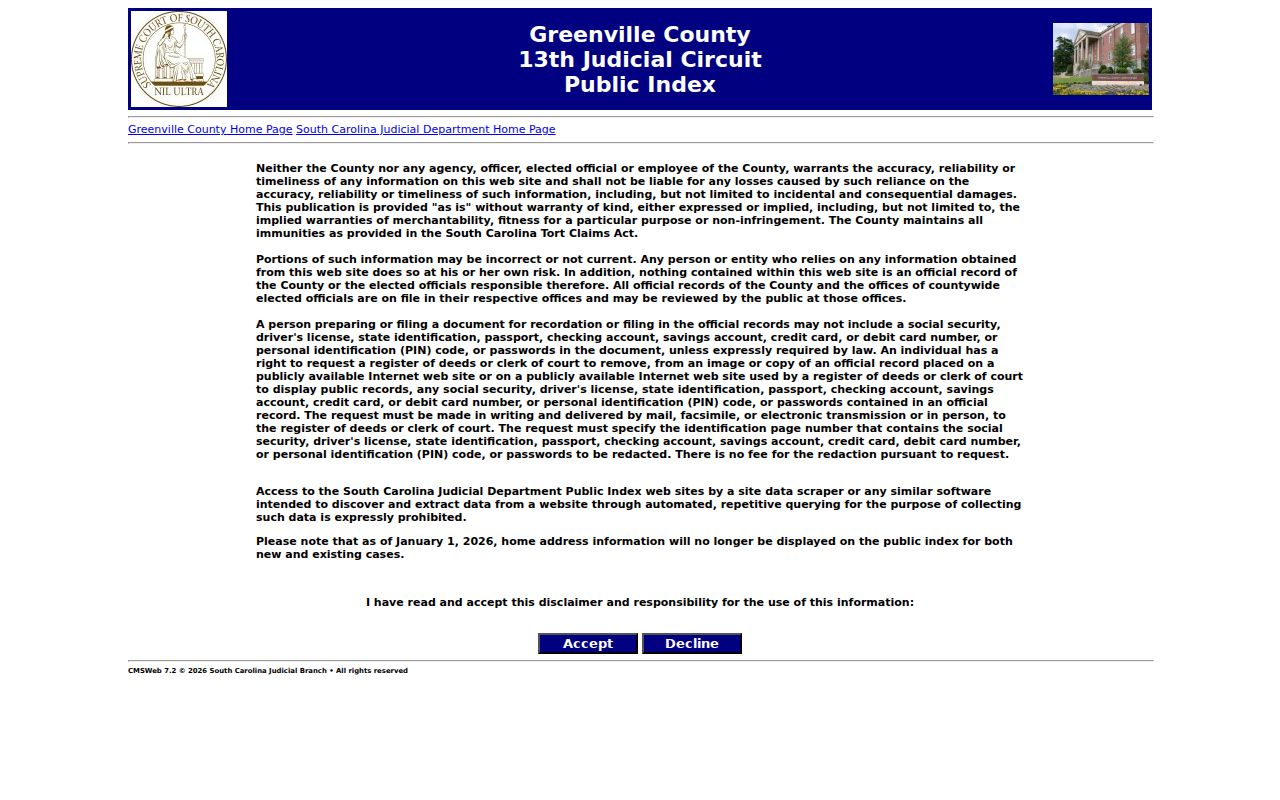
The Judicial Branch guide directs a searcher to choose Greenville County, read the county disclaimer, and accept it before entering criteria. Use a simple name search first. The portal combines supplied criteria, so a broad name plus too many filters can hide a valid hit. The name control supports beginning letters or a partial word with a Contains option. That makes it useful for initials, suffixes, punctuation, and spelling variants, but a result remains an index entry until the Clerk confirms the public file.
| Public Index field or result | Documented use |
|---|---|
| County map or search bar | Select Greenville County before case criteria. |
| Case number | An optional full 13-digit civil action number can be entered without dashes. |
| Last Name-Business and party type | Use partial words or Contains, then narrow by plaintiff or defendant when appropriate. |
| Action type and date range | Pair action type with filing, disposition, judgment, or arrest dates. |
| Tax Map number | A real-estate case aid, not an address or occupant field. |
| Court, agency, case type, and subtype | Filters that help distinguish civil, criminal, and appeal matters. |
| Case link, Actions, Financials, documents | Results appear in a grid; available tabs and document icons open further public detail. |
The Greenville County Trial Court Public Index is shown in the official search capture below. Its documented result inventory includes the linked case number, party and party-type filters, court and case type, action-date context, Actions, Financials, and documents when an icon is enabled.
Most Common Pleas civil case images are described as online and printable, while General Sessions searches show file information online. For a missing public file, the Clerk of Court copy policy lists inspection and copy channels, including older off-site files that are generally available after a request.
Note: Sealed, juvenile, adoption, dismissed-warrant, and other protected records remain outside an ordinary name search.
Mauldin Property Record Names
Use Greenville County Real Property Search when a name or address may connect to land. Its entry screen requires a tax year and accepts one text route at a time: name, street, map number, subdivision, or sales sheet number. The County illustrates a name in last-first order. Record the exact indexed spelling and the map number before moving on. The public research did not capture a redacted parcel-result card, so do not assume a particular field order or treat an unverified screen label as a fact.
Next, search the Greenville County Register of Deeds by the owner or party name, then match the legal description, lot, block, or plat reference to the county parcel. The ROD has an online post-1985 route and separate older index-book, deed, land-grant, and some mortgage materials. It is a party-and-document index, not a promised house-number search. For a full address-chain method, use the Mauldin By Street directory after a name search establishes the parcel clue.
Note: Preserve the legal description before treating a deed as the same property named by a current assessment search.
Mauldin Ownership Is Not Occupancy
A property owner and a person living at an address are not necessarily the same person. The assessment system maintains ownership and legal-description information and processes owner mailing-address changes. A situs address identifies the physical parcel. A mailing address is correspondence for the tax account. Either can be useful for a cross-check, but neither lists every person in a home or proves that a tax-mail recipient physically lives at the Mauldin situs.
This distinction prevents a common error in a resident lookup. Compare the tax year, map number, legal description, and the recorded document before connecting records. A legal-residence or homestead-related field, if a current card displays one, is assessment evidence that should be confirmed with the custodian. It is not a substitute for an occupancy record. A later deed may show a transfer, but it cannot supply the date a former owner moved away.
Mauldin Marriage Record Trails
Greenville Probate Court offers estate, guardianship, conservatorship, marriage-license, and public case-information routes. An estate may identify a decedent, a personal representative, or interested parties. That makes it useful for a family-history or heir question, provided each role is read in context and not mistaken for a current address. The marriage-license search has Bride Name, Groom Name, and License Year fields. A party may opt out of online display while still being able to obtain a certified copy, so no web result is not proof that a license does not exist.
The official Greenville marriage-license search appears in this capture. For a record that needs verification, Probate Court lists its Records Division at 301 University Ridge, Suite N-T100, with a records phone channel at 864-467-7684. The County’s online access is a discovery route; ask the court which public copy or certificate channel applies to the specific record.
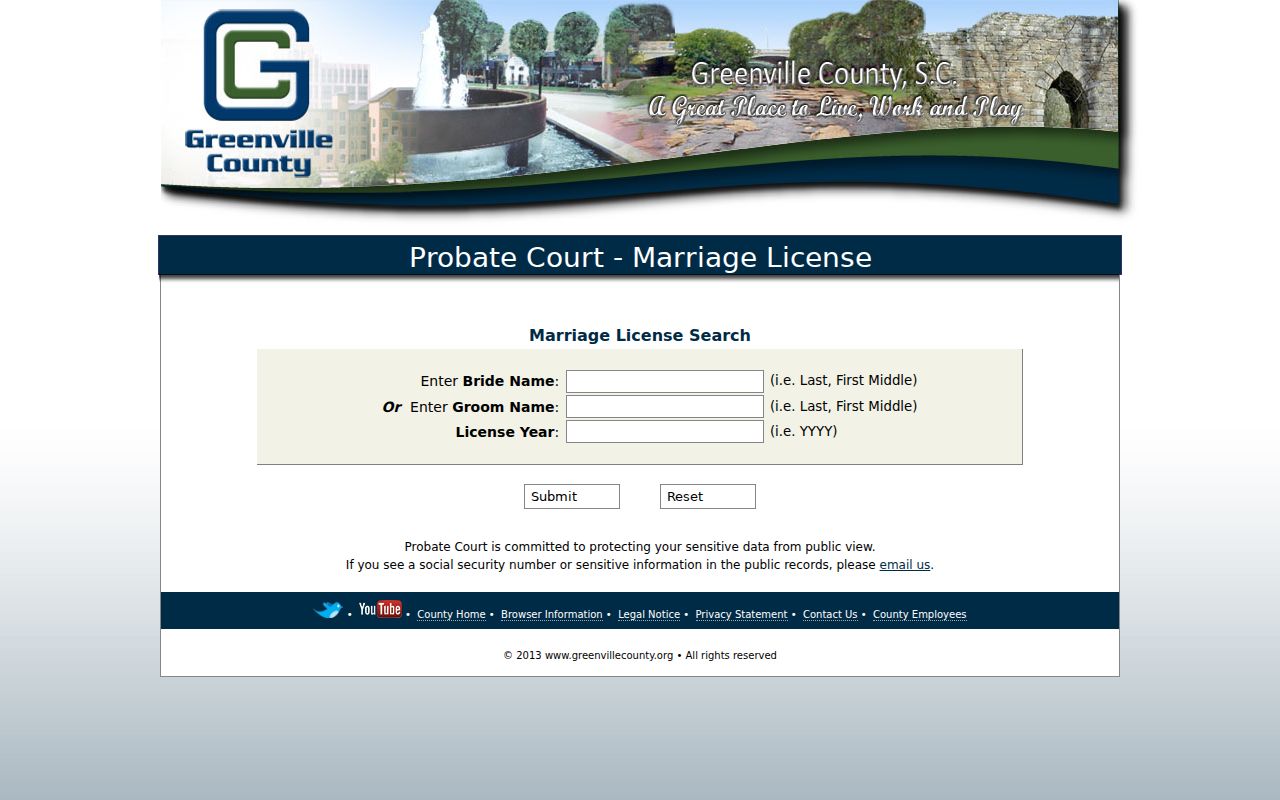
The search image supports a narrow name-and-year inquiry, not a broad resident list. Probate records and license records work best when paired with a known date, court, or property connection.
Verify a Mauldin Resident
A careful Mauldin resident lookup uses two or more records that answer different parts of the question. Begin with a source that has a concrete identifier, then check whether the name, date, map number, case number, or legal description continues across the next official source. Do not merge two records because their surnames match. The strongest check is a consistent chain with a clear custodian for every link.
- Search Real Property Services by the available name, street, or map number, using one entry field at a time.
- Keep the exact name spelling, parcel clue, tax year, and situs details that identify the property record.
- Search the ROD for a matching party and document, then compare its legal description or plat reference to the parcel.
- Run the county-limited Public Index for the name and variants, comparing party role, case number, court, and dates.
- Ask the Probate Court, Clerk, or DPH custodian for the appropriate public copy when the underlying record matters.
- Docket
- A court case’s organized sequence of filings, events, and dates.
- Index versus image
- An index points to a record; an image is a viewable document when the custodian makes it available.
- Certified copy
- A custodian-issued copy that carries the office’s certification, unlike an ordinary search printout.
Matching middle initials, document dates, and a parcel or case identifier does more work than a name alone. If the evidence conflicts, return to the office that created the record instead of resolving the conflict from a search snippet.
Mauldin Vital Record Time Limits
South Carolina DPH Vital Records is the statewide custodian for birth, death, marriage, and divorce products. Its rules are more limited than a land index. South Carolina births become available for public viewing after 100 years and deaths after 50 years, as uncertified records. Current marriage and divorce products are issued under statutory eligibility rules, though an ineligible requester may receive a date-and-county statement in the circumstances DPH describes. The Greenville County Regional Vital Records Office is the local service channel, but current availability should be checked before a visit.
The official DPH vital-records page appears in the capture below. DPH lists a $12 nonrefundable search that includes one certified copy if found, $3 for additional copies, and a $5 expedited option that is not available by mail. Mail processing is described as about four weeks, while online or telephone service estimates can differ. A marriage outside DPH’s stated range belongs with Greenville Probate Court; a divorce decree belongs with the Clerk of Court where filed.
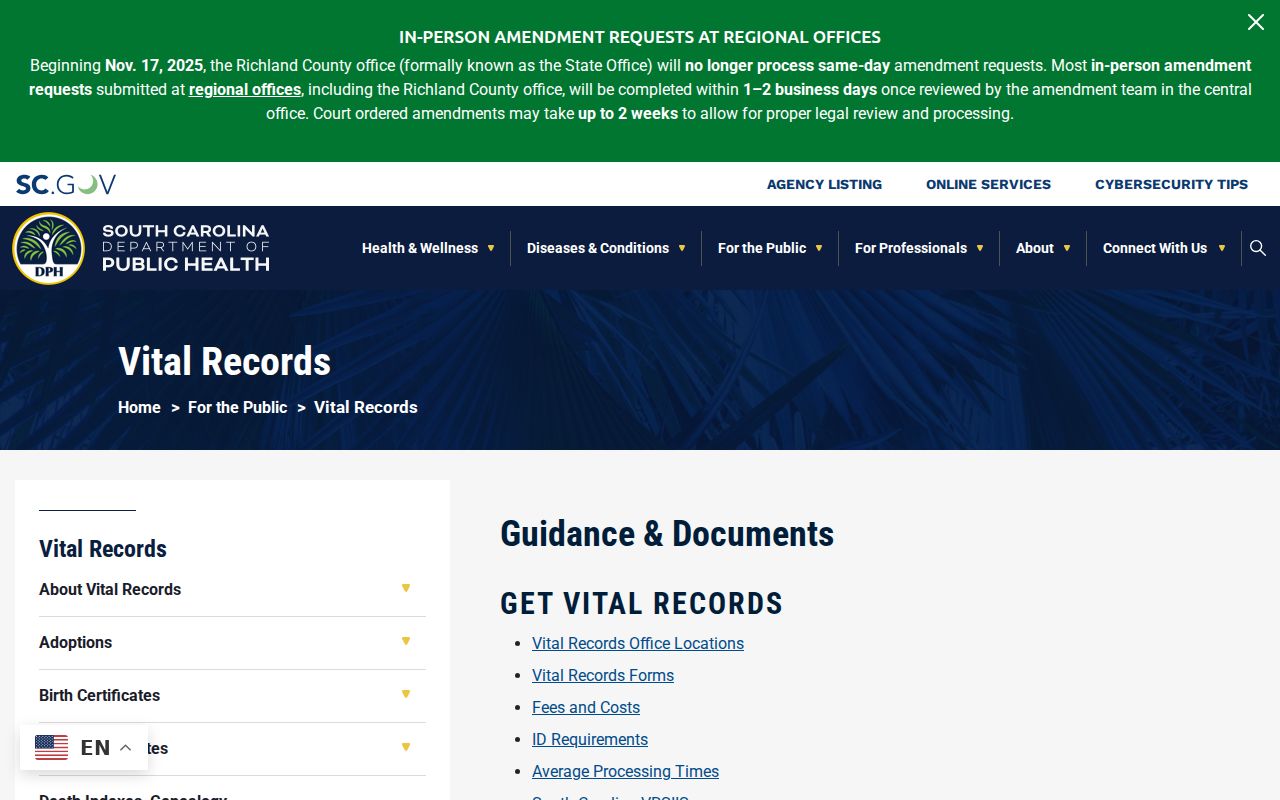
The DPH capture is a request route, not an open name-search screen. A historical index can be a lead for family history, but it does not override the certificate rules or release a restricted record.
Note: A public-viewing threshold does not turn a historical vital record into a certified copy for every requester.
Mauldin Resident Lookup Boundaries
South Carolina FOIA can allow inspection, copying, or electronic transmission of public records, subject to exemptions and other laws. It does not require an agency to create a new resident list. The Attorney General’s Address Confidentiality Program uses a designated address for qualifying participants, and other protected categories include sealed court material, juvenile and adoption records, protected voter-address information, and motor-vehicle data covered by federal law. An official record may remain available even when a commercial display is removed, and a commercial removal request does not change the government record.
Lawful use. Use Mauldin records for personal, lawful research. Never use a name, address, or record to stalk, harass, threaten, or harm another person.
For a factual error, contact the office that holds the source. Real Property Services and the ROD handle their own indexing and document questions; the elections office handles voter matters; the Clerk handles court index questions; and DPH handles its vital products. Keep the record URL or number, date, response, and supporting proof with any correction request.
Mauldin FOIA Record Requests
When an online index ends, make a narrow request under the South Carolina Freedom of Information Act, Title 30, Chapter 4. Identify the custodian, record category, person or parcel, bounded date range, desired inspection or copy format, and willingness to accept redaction or an estimate. A request to the Greenville office that created the record is more useful than asking an agency to locate a person. The City’s current media and FOIA route is appropriate for a defined municipal record that is not online.
FOIA is a fallback for a specific public record, not a way around restrictions on vital, protected-address, or sealed material. A focused request also gives the custodian enough detail to identify the correct file and explain any limit that applies.
Note: Ask for an existing record and a bounded time period instead of an agency-created list of names.