
Mauldin City Directory Shelves
There is no separately published historical city-directory series for Mauldin in the inspected sources. The practical collection geography is Greenville, Greenville County, and the surrounding vicinity. That limitation matters. A Greenville title may omit a small or rural Mauldin household, while later county, telephone, and cross-reference publications are clearer Mauldin leads. Search both the city name and the older Butler's Corners or Butler's Crossroads forms, then test the result against the address and the year of the volume.
| Collection | Years | Where held | Access |
|---|---|---|---|
| Greenville County Historical Society city directories | Holdings begin in 1883 | Greenville County Historical Society | Appointment required; a Mauldin index is not promised |
| Hill's Greenville directory | 1931, 1933, 1935, 1938, 1940-1965 with gaps, 1967-1974, selected issues through 1980 | Hughes Main South Carolina Collection / Archive | Reference only; verify geographic coverage inside each volume |
| Greenville Polk directory | 1987 and 1992-1996 holdings; 1983 issue described | Hughes Main reference / archive | Library use only |
| Greenville and Pickens Polk directory | 1997-2005 archive issues; current 2025 reference volumes | Hughes archive and Mauldin branch | Library-use-only print reference |
| Consumer and business guide for Greenville and vicinity | c2007 onward | Hughes Main and Mauldin reference locations | Annual cross-reference and reverse-phone lead |
These catalogued runs establish where to begin, not that every year lists every Mauldin address. The South Carolina Room guide recommends directories at call number SC 917.5727 as part of a home-history search and cautions that city limits change. The period of publication, the publication's stated geography, and the exact printed street form all deserve a note in the research log.
Mauldin Directory Research at Hughes
The South Carolina Room at Hughes Main Library, 25 Heritage Green Place in Greenville, is the primary public-library stop for Mauldin directory work. Its local-history and genealogy holdings include family files, manuscripts, maps, microform, newspapers, periodicals, photographs, reference books, and research computers. A Book Eye scanner and microfilm reader/scanner can download or email images. The Library recommends an appointment. Reach the room at scroominfo@greenvillelibrary.org or 864-527-9212 before making a trip.
The W. Jack Greer branch offers public computers, scanning, faxing, and one-on-one librarian bookings. It is a convenient place to begin a catalog search or arrange help, although archival work belongs at Hughes. The library system also identifies some genealogy databases as in-library resources, while HeritageQuest is available with a library card. Treat a database hit as a lead, and preserve the volume title and page reference when it points to a directory entry.
See the Greenville Library South Carolina Room before planning a visit or requesting staff help.
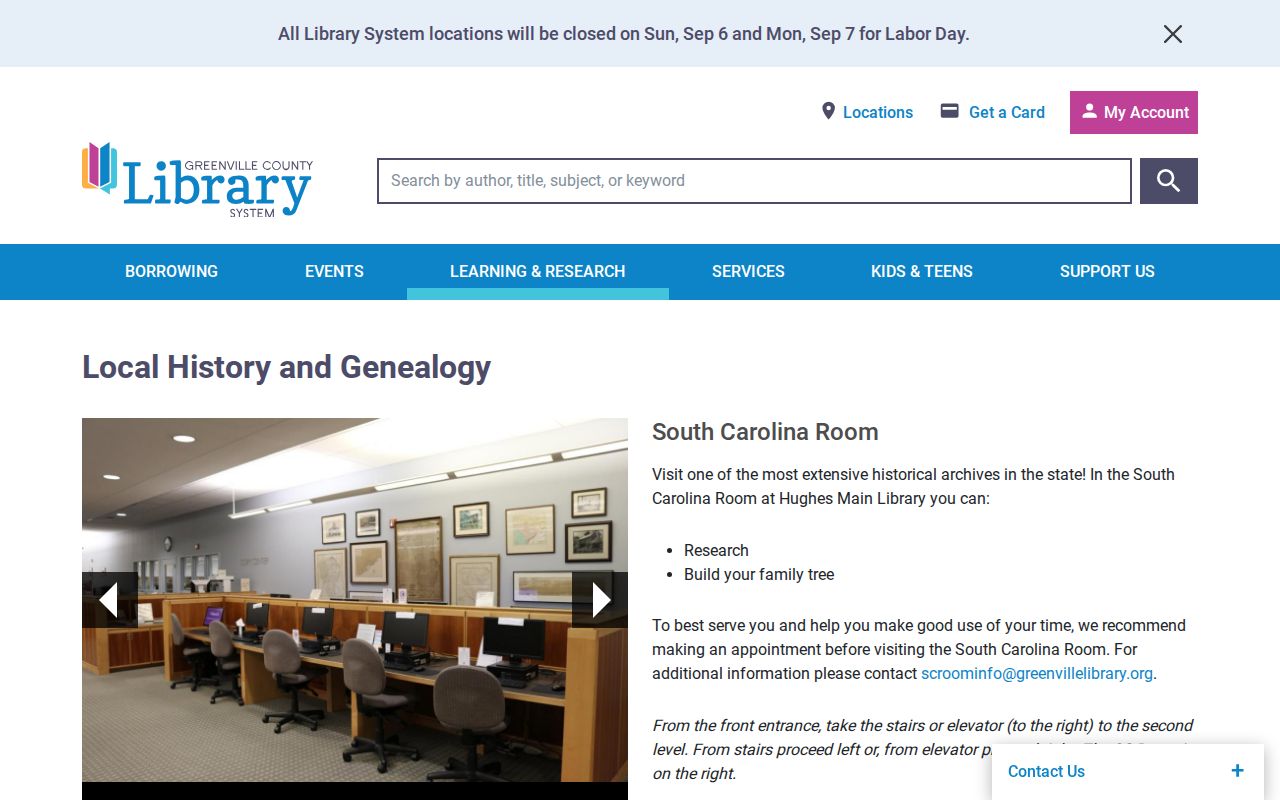
The library destination is the access point for the regional reference shelf, microfilm, and staff-assisted local-history work behind a Mauldin directory search.
Mauldin Directory Years in Greenville Volumes
The Hill's Greenville catalog record supplies the clearest long run at Hughes. National Park Service documentation also cites Greenville directory issues from 1917-18, 1919, 1921-22, 1923, 1924, 1928, and 1930-1980 under Hill or Miller titles. Those citations establish a publisher and date trail, not open online access or Mauldin coverage within each issue. For later research, the Polk catalogues bridge the post-Hill period, including a current family that explicitly includes Greenville and Pickens counties.
The timeline is useful for choosing a shelf call. It does not turn a Greenville listing into proof that the household was within the present Mauldin boundary.
| 1883 | Historical Society city-directory holdings begin, according to the State repository directory. |
|---|---|
| 1931-1980 | Catalogued Hill holdings and selected archive years form a major Hughes run, with documented gaps. |
| 1987-1996 | Catalogued Greenville Polk issues provide a later bridge. |
| 1997-current | The Greenville and Pickens Polk family continues in archive and reference locations. |
Open the Polk city-directory catalog record to confirm the current volume family and its library-use-only status.
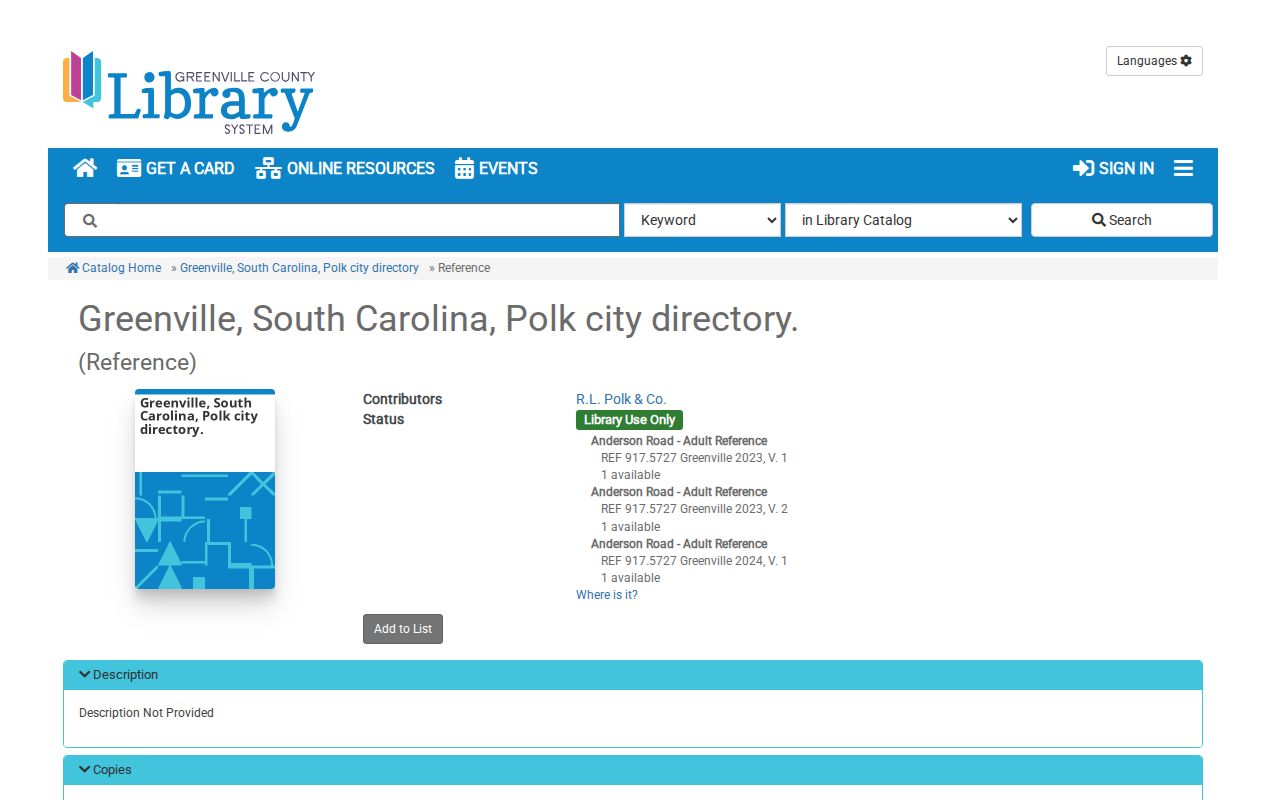
The catalog view is a finding aid for a physical reference collection, so the volume itself remains the place to verify a date, address, or notation.
Reading a Mauldin City Directory Entry
No readable Greenville or Mauldin resident entry was publicly reachable during the research run. The catalogues verify titles, publishers, dates, locations, and reference-only status, but they do not verify a specific printed field layout. That is an important limit. Record only what the particular volume visibly prints, and photograph or transcribe its own abbreviation key before interpreting a symbol. A directory listing should never be treated as proof of ownership, complete household composition, or a current address.
| Name form | Record the surname, initials, and spelling variants exactly as printed. |
|---|---|
| Address | Record a printed address when present, then compare it with period street naming and parcel evidence. |
| Occupation or business clue | Preserve it only if the volume displays it; the inspected research did not verify a standard entry layout. |
| Abbreviations or marks | Use the key in that same volume, if supplied. Do not assume an owner, renter, spouse, or widow notation. |
- Criss-cross directory
- An address-first directory arrangement, useful only when a verified volume actually includes that section.
- Householder index
- A name-oriented index that may point to a household listing; confirm its scope in the printed volume.
- Abbreviation key
- The volume's own explanation of shortened labels or symbols. It controls the meaning of that edition's marks.
Mauldin Cross-Reference Directory Leads
The Consumer and Business Guide for Greenville and vicinity is catalogued as an annual publication from about 2007 onward and is also described as a cross-reference or reverse-phone directory with a Mauldin directories subject heading. That makes it a useful address-to-name lead for the years the relevant issue actually covers. The sources inspected did not verify a separate historical Mauldin reverse-directory run, publisher, shelf location, or sample page. Ask the South Carolina Room rather than filling that gap with assumptions.
For an address that needs a present-day parcel cross-check, use the Mauldin by-street directory approach after preserving the historical form. It starts with county property records and keeps a parcel's legal description separate from a household listing. Old deeds may use a lot, block, subdivision, or plat reference instead of the street number that appears in a later volume.
Note: A reverse or cross-reference listing is an address lead for its printed year, not evidence of current occupancy or title.
Trace Mauldin Households Across Directory Years
Use a directory trail in small, dated steps. Start with a surname in a Greenville or Greenville County volume that actually reaches the needed geography. Preserve the address, initials, and any printed work clue. Move to the next available issue instead of assuming an unheld year exists. The National Archives census guidance says the latest released federal population census is 1950 under the 72-year restriction. From 1850 through 1950, schedules can identify household members; the 1790-1840 schedules usually name only the head of household.
- Find the surname and check the issue's geographic reach before copying the listing.
- Record every spelling, initial, printed address, and page reference from that year.
- Compare the closest available directory issue before and after it for an address or name change.
- Pair the directory year with the nearest released census, keeping the census date separate from the directory date.
- Use a deed, plat, or historical property record to test whether the address and parcel describe the same place.
A name that disappears may reflect a move, a changed spelling, a different publication scope, or an unlisted person. The Mauldin resident lookup route can help verify a modern record, but it should not be used to force a historical directory lead into a present-day identity.
Mauldin Records Before the City Name
Mauldin's older names are a real directory-search issue. The City's history identifies Butler's Corners and Butler's Crossroads in 1868, a first town charter in 1890, reincorporation in 1910, charter revocation in 1932, and reincorporation in 1957. A record filed during the inactive-charter period may use a crossroads, road, or county label rather than a municipal name. It should be tested against its road, parcel, and Greenville County context instead of being discarded.
The City of Mauldin history also places the 1886 depot and later Golden Strip development in the local timeline. These facts explain name variation. They do not identify a resident of a particular address. For older land context, the State Archives guide notes Greenville County conveyance books beginning in 1787, alongside other early county record series.
Mauldin Obituaries and Record Books
Directories work best beside dated local sources. Greenville County Library System indexes Greenville News obituaries from 1901 to the present and marriage announcements from 1990 to the present, with TOWN magazine announcements from 2011 through 2023. Its genealogy resources also point to historic American newspapers and the public-domain Greenville Piedmont collection. Record the newspaper title, date, and page so the South Carolina Room can retrieve the correct microfilm item.
The Library records-request form offers defined remote search types. It lists $5 vital and newspaper searches, plus $15 deed and probate searches, prepaid and nonrefundable. Greenville County's Historical Records collections add conveyance indexes, plats, mortgages, probate material, court records, and sheriff books. Online images also exist on SC Room microfilm, while additional material remains with the originating office.
Mauldin Directory Requests Beyond the Shelf
The Greenville County Historical Society is another in-person route for Mauldin directory and map research. The State repository directory describes holdings from 1844 to the present, including county papers, records, and photographs, while the Society reports more than 5,000 historic photographs from the 1890s through the mid-twentieth century. Its directory holdings begin in 1883, and it also holds Greenville Sanborn maps for 1920-1951. Contact the Greenville County Historical Society at 864-233-4103 or info@greenvillehistory.org before visiting.
Not every record is digitized. Greenville County says its online historical images are a selected, microfilm-derived group, and original, microfiche, and microfilm material may remain at the responsible office. A focused staff inquiry with a name variant, address, date range, and record type is more useful than a request for a general list. That approach preserves the limits of a Mauldin city directory while still opening the archive channels behind it.